I chose to animate an undead character and try to utilise the quality of movement you get with stop motion animation and use this to my advantage to create a stylised jerky walk. It turned out okay but I think this would benefit from a better character model.
Wednesday, 2 December 2015
Animation - Skeleton Walk
Continuing further into the exploration of lighting and darker atmospheres, I created a short scene involving a skeleton walking down a corridor. With the factory scene, the LEDs were nice to work with but I felt needed something more. After looking at Corpse Bride, they also added green lights in addition to the red in one scene. I didn’t have any green lights so went with a standard torch which helped to add more depth to the scene; however I only used this for brief flashes.
I chose to animate an undead character and try to utilise the quality of movement you get with stop motion animation and use this to my advantage to create a stylised jerky walk. It turned out okay but I think this would benefit from a better character model.
I chose to animate an undead character and try to utilise the quality of movement you get with stop motion animation and use this to my advantage to create a stylised jerky walk. It turned out okay but I think this would benefit from a better character model.

Tuesday, 1 December 2015
Animation - Factory Scene
From observing other animated movies, I wanted to explore the use of lighting in my animations. Taking some influence from my earlier exploration into machinery and clockwork parts, I wanted to create a factory scene. I wanted to use stop motion here to get the quality of motion often associated with the medium. The imperfect consistency in movements is a natural product of the process, and this gave the machinery a slightly mechanical movement to it which I liked. I used a set of Red LEDs which I also moved and animated in each frame. The light that hit off the walls and machine parts quite well for the visual effect I wanted to achieve.
Skills Development
Before the start of this project, during the summer, I was taking early steps to prepare with my honours project. I wanted to include stop motion animation in the project but did not know how or what I’d be looking at.
I worked on a stop motion animation project on the side during the summer and during the first several weeks of the semester. Although the work I created for this project was not applicable to the honours project, without that work, the honours year research project would probably not be where it is today. I do consider the skills developed to be applicable to this project.
The side project involved studying the use of cinematography and editing techniques by re-creating existing media in stop motion animation using Lego bricks. I chose to look at a trailer for the upcoming Batman v Superman: Dawn of Justice movie, out of personal preference and as something that contained a lot of challenging sequences.
Through creating various shots, I learnt how to translate real world filmmaking techniques into something practically achievable through stop motion. Stop motion has its limitations but working with them gives those animations a certain charm.
Some techniques I tried out are:


Using additional lights to add visual effects such as lightning or explosions.
Camera Movement
Following the path of action in a character, the camera “lags” behind the movement by a frame or two to feel more natural, as if a person was filming in real time.


Removing something in post production to make it look like something is flying or in the air during an action. By keeping the flying object as close to its actual position in the scene, the lighting on that object will keep it feeling real within a scene. Artificial shadows can be added to emphasise this.
I worked on a stop motion animation project on the side during the summer and during the first several weeks of the semester. Although the work I created for this project was not applicable to the honours project, without that work, the honours year research project would probably not be where it is today. I do consider the skills developed to be applicable to this project.
The side project involved studying the use of cinematography and editing techniques by re-creating existing media in stop motion animation using Lego bricks. I chose to look at a trailer for the upcoming Batman v Superman: Dawn of Justice movie, out of personal preference and as something that contained a lot of challenging sequences.
Through creating various shots, I learnt how to translate real world filmmaking techniques into something practically achievable through stop motion. Stop motion has its limitations but working with them gives those animations a certain charm.
Some techniques I tried out are:
Lighting


Using additional lights to add visual effects such as lightning or explosions.


Adding lights to illuminate certain objects in a scene.
Camera Movement


Following the path of action in a character, the camera “lags” behind the movement by a frame or two to feel more natural, as if a person was filming in real time.
Masking
Removing something in post production to make it look like something is flying or in the air during an action. By keeping the flying object as close to its actual position in the scene, the lighting on that object will keep it feeling real within a scene. Artificial shadows can be added to emphasise this.
Backgrounds
Avoiding digital backgrounds where possible. The use of printed backgrounds in this scene actually gave it a more charming quality to the animation, emphasising the physicality of the real world set.
Friday, 27 November 2015
Case Study - ParaNorman

ParaNorman is a 2012 stop motion animated film produced by Laika Entertainment and directed by Chris Butler and Sam Fell. It is the second feature length film Laika have produced and was nominated for an Academy Award for Best Animation.
How Stop Motion is Used in the Film
The whole movie features stop motion characters and set. CGI is used sparingly to enhance background details and add addition visual effects. Like Coraline, ParaNorman uses 3D printing technology to assist in the facial animation of characters. Faces are created in 3D software packages, printed out and swapped in each frame to create the character performance.

The stop motion in this movie focuses heavily in creating subtler and more accurate performance through the use of 3D printing technology. The movement is smoother and therefore is not as much evidence that there is stop motion being used.
Common Themes
ParaNorman continues with a mild horror theme that Laika featured in their earlier film Coraline. The film deals with ghosts, the undead and witchery. While targeted towards families, the film does deal with mature themes such as the story of the character of Agatha and her accusation of witchcraft.
In 2012 there were a number of stop motion films released including ParaNorman, Frankenweenie and The Pirates! In an Adventure with Scientists! Two of these were horror based which stop motion has numerous examples in this genre.
Stop Motion Techniques
A
scene in particular I observed which utilised stop motion for visual appeal is
the scene near the end where Agatha is challenged and Norman tries to calm her
down. There is a good use of texture in
the forest: the trees and ground feel very traditionally crafted. As Agatha
gets more upset the world changes around them becoming more of a distorted
reality. I liked how CGI enhanced but didn’t take away from the stop motion
charm in Agatha’s character performance. Finally as she calms down, the
environment changes into something more pleasant, with cleaner textures and
brighter lighting. These are all things that could've been done in CGI or
another animation medium, but there’s something quite special about using stop
motion to create something very visually rich and unique.


Friday, 20 November 2015
Case Study - The Nightmare Before Christmas

The Nightmare Before Christmas is a 1993 stop motion film directed by Henry Selick and based on the story and characters by Tim Burton.
How Stop Motion is Used in the Film
The film is a well known stop motion animated film. The characters and sets feel real and the quality of motion comes across as a traditional stop motion film, featuring the odd jerky movement that we associate with the medium. Overall the animation in the film is very convincing and there is a real sense of physicality to the look of the movie. In scenes such as the Christmas town and the forest, the depth of the closed sets give the illusion these worlds are enclosed, and separated from reality.
Texture
The Nightmare Before Christmas features a lot of texture in its sets and characters. The film takes place mostly in outdoor locations in a fictional universe. Textures are used effectively to separate the different locations of the Halloween town, the Christmas town and the "real" world. Halloween town use a lot of unnatural textures that make up their characters such as Sally who is threaded together.

The film has a distinct Halloween or gothic look to it, featuring a lot of well known fictional characters based around Halloween. I remember as a kid finding some scenes and characters pretty creepy but not too creepy where it became unwatchable. Maintaining a visual style and not straying into uncanny territory helped the film to achieve this. I think this was important as it allowed the story to be told while also including story elements that involve scaring children.
Compared to Corpse Bride, the colour palette is a lot duller, which helps to convey the grim atmosphere that the Halloween town has. This contrasts with the Christmas town and the positive atmosphere it has. As the movie progresses the Halloween town brightens up over time.
Thursday, 19 November 2015
Animation - Paper Cut Out
I really liked how the technique of layering materials over a lightbox turned out for the rice
animations so I tried adding layers of paper to create a simple environment.
I made a simple character made from cut-out card that had a limited degree of movement and animated him walking across the screen.
The camera was set to give a contrast between the light and dark. I turned up the exposure and contrast, while reducing the colour saturation. Positioning a light beneath the table illuminated the set well and each additional layer of paper reduced the light shining through.
Overall I like the visual look of this appears. I was inspired by the likes of Limbo, a game which has a similar aesthetic. While the animation doesn't have a lot going for it due to the limited character movement, I like the quality of movement it has as it walks across the screen. It was challenging to keep this character's limbs in position while moving others and sometimes the layers of paper would lift up preventing the character from sliding across the surface.
Thursday, 5 November 2015
Progress Presentation Feedback
Earlier this week I presented the progress so far regarding my honours year project. The presentation can be viewed via Google Drive.
In the presentation I explained my background in stop motion animation and that it is something that I'd like to try in university. In explained how I started with a lot of questions which have guided me so far but many remain unanswered and that I was not certain on my research question for the project just yet. However the rough direction I was going in asked the questions:
It is my goal to make a short animated film in second semester but I'd be focusing more on the animated craft rather than narrative or characterisation where I am not as skilled. The film would include things I'd learn through researching throughout the year.
I described some of the techniques that Barry Purves had mentioned in his book Stop Motion: Passion, Process and Performance such as the use of texture and lighting.
I showed some of the animation work I'd done so far such as the short fight scene and the rover on the alien planet animation. I explained how I'd tried to understand how some elements of using stop motion are unique to that medium however I was aware that some of the animations were made purely for the sake of making and that I'd hope to uncover questions to ask by animating.
I also mentioned how I'd started to study films by identifying common themes and elements and comparing them to other films I'd studied. I was building a framework that would help my analyse other films and I'd build upon it to get an understanding of the visual appeal of stop motion.
Some examples of texture and materials were shown and I described some ideas I had for the coming weeks for what to try next. Finally I showed some further reading material that I was interested in looking at. Examples of which can be found in the presentation slides linked at the top of this post.
I received feedback from tutors Lynn Parker and Simone O’Callaghan. The response was overall positive and the feedback was informative, the main points being:
In the presentation I explained my background in stop motion animation and that it is something that I'd like to try in university. In explained how I started with a lot of questions which have guided me so far but many remain unanswered and that I was not certain on my research question for the project just yet. However the rough direction I was going in asked the questions:
- What is the appeal of stop-motion animation?
- Why would an animator choose stop-motion over other mediums?
- What are the processes behind stop-motion animation?
- How can I use stop-motion animation to better my skills at animation and filmmaking?
It is my goal to make a short animated film in second semester but I'd be focusing more on the animated craft rather than narrative or characterisation where I am not as skilled. The film would include things I'd learn through researching throughout the year.
I described some of the techniques that Barry Purves had mentioned in his book Stop Motion: Passion, Process and Performance such as the use of texture and lighting.
I showed some of the animation work I'd done so far such as the short fight scene and the rover on the alien planet animation. I explained how I'd tried to understand how some elements of using stop motion are unique to that medium however I was aware that some of the animations were made purely for the sake of making and that I'd hope to uncover questions to ask by animating.
I also mentioned how I'd started to study films by identifying common themes and elements and comparing them to other films I'd studied. I was building a framework that would help my analyse other films and I'd build upon it to get an understanding of the visual appeal of stop motion.
Some examples of texture and materials were shown and I described some ideas I had for the coming weeks for what to try next. Finally I showed some further reading material that I was interested in looking at. Examples of which can be found in the presentation slides linked at the top of this post.
I received feedback from tutors Lynn Parker and Simone O’Callaghan. The response was overall positive and the feedback was informative, the main points being:
- They both seemed to like my presentation and thought I'd put in a good amount of work. Lynn and Simone both have a soft spot for stop motion animation so the familiarity with the subject helped them to see how I may continue the project in the future.
- I talked a lot about focusing on the process of stop motion, but I should perhaps read more about the others aspects of stop motion and the exploring the process will come naturally.
- I should expand more upon the imperfections of stop motion animation and what affects they can have on the quality of the animation such as its style or influence on genre. There is potential on this path if I choose to look further into it.
- I mentioned the potential creepiness stop motion can evoke but I only scratched the surface. There are particularly grotesque stop motions by people such as Jan Švankmajer. I had mentioned Quay brothers but admitted that I hadn't explored their work as much as I'd liked. I think it'd be good to look at all of the mentioned directors to understand what kind of darker animations can be made with stop motion.
- I was suggested to also check out a documentary about Cosgrove Hall and a film called Tale of Tales (1979) which is considered by some to be one of the best stop motion animations.
- Begin to look at concepts and ideas for the final outcome.
- I could use questionnaires or interviews to question other animators about the quality of motion in an animation.
Overall I am happy with the presentation and feel more confident in the work I am doing. For my next presentation I will start it earlier and talk with a tutor beforehand. A lesson learned from this presentation is that I left the slides and practice too late which led me to be pretty nervous and I'm aware that I must have seemed like a nervous wreck while talking.
Looking forwards, I can begin to think about new practical exercises to do, and what purpose I have for doing them that relates to my project aim. The next hand-in is the project proposal which is where I will better clarify my intentions for the project's direction. I will also need to come up with a more concise research question.
Tuesday, 3 November 2015
Animation - Fighting
Something
that 3D computer animation does very well is camera movements, because you can
animate the character performances then worry about the camera movements later
which you can alter at any time. With stop motion, camera movements are set in
stone as soon as you include them and they are difficult to change later in
production.
I wanted to
how stop motion camera movements affect the physicality of a stop motion. By moving
the camera around the set, you get a sense of its scale and depth. I think it’s
something that adds quite a bit of visual style to an animation as it feels
more personal and natural compared to digital panning or zooms.
Sunday, 1 November 2015
Animation - Rover Exploration
This animation set out mostly just to create something, focusing more more on the production pipeline of stop motion animation. I wanted to test out some camera and editing techniques. As I've not really got a research question, I hoped by just making something I'd be one step closer to having a research question. While I'm still not entirely sure what my research question is, I do think I have a better idea of the practical exercises I want to attempt next.
As mentioned in a previous post, the character design came from a doodle which I created a Lego model from. I chose to use Lego as it was a material I had available at the time from working on a previous project in the Summer. However I wanted to try something different with the Lego and instead of using their minifigures I wanted to create something from scratch. The series of character models I made each had a unique mechanical feature. The character that I animated with was able to use a mechanical arm to dig up and store soil samples to analyse.
As for techniques, I tried out a few techniques. Something I always enjoy doing is moving the camera around a scene because it's unlike a live action camera as you have to move the camera in small movements which you can't easily plan out so you have to wing it and hopefully get a feel of how it will turn out. The camera in a few shots track the rover as he navigates the environment and looks at an unusual rock.
The animation presented a few challenges. In particular, the size of the set I built wasn't always big enough for the camera angles I decided upon. The background plate I had wasn't big enough to be static so I made the decision to move it with the camera, something which turned out all right as it appeared the sky was static and therefore far off in the distance. However due to the imperfections of moving it every frame, it was still clearly a stop motion background and that added to the charm of the animations visual style.
I am happy with this animation. While it doesn't show particularly strong animation, I was happy with the length and process behind the making of it. I liked that it was something different that I hadn't tried before. Overall, the animation was intended to explore stop motion in the hope that I could discover new ways of thinking that could inform my practice.
As mentioned in a previous post, the character design came from a doodle which I created a Lego model from. I chose to use Lego as it was a material I had available at the time from working on a previous project in the Summer. However I wanted to try something different with the Lego and instead of using their minifigures I wanted to create something from scratch. The series of character models I made each had a unique mechanical feature. The character that I animated with was able to use a mechanical arm to dig up and store soil samples to analyse.
As for techniques, I tried out a few techniques. Something I always enjoy doing is moving the camera around a scene because it's unlike a live action camera as you have to move the camera in small movements which you can't easily plan out so you have to wing it and hopefully get a feel of how it will turn out. The camera in a few shots track the rover as he navigates the environment and looks at an unusual rock.
The animation presented a few challenges. In particular, the size of the set I built wasn't always big enough for the camera angles I decided upon. The background plate I had wasn't big enough to be static so I made the decision to move it with the camera, something which turned out all right as it appeared the sky was static and therefore far off in the distance. However due to the imperfections of moving it every frame, it was still clearly a stop motion background and that added to the charm of the animations visual style.
I am happy with this animation. While it doesn't show particularly strong animation, I was happy with the length and process behind the making of it. I liked that it was something different that I hadn't tried before. Overall, the animation was intended to explore stop motion in the hope that I could discover new ways of thinking that could inform my practice.
Although this animation’s tone is different to that of the
films I’ve looked at in my research, this was more inspired by TV series I was
looking at such as Clangers (BBC 1969)
and Chorlton and the Wheelies (ITV
1976). The animation uses Lego bricks but doesn’t include the traditional
minifigures.
I wanted to see if the use of stop motion would help to enhance the quality of the characters movement. The little bumping movements as he navigates the landscape feel natural and gives the character an innocent or chirpy quality.
I also encountered a technical problem with my camera where it changes contrast and brightness without explanation, even on manual settings. I've put this down to either a graphics problem on my laptop or the age of my camera which has been running for a good number of years but acts up from time to time. I was able to colour correct any frames affected and it isn't too noticeable (other than the last few seconds of the animation).
Thursday, 22 October 2015
Storyboard Idea
This week I've started animating a small scene revolving around a space exploration rover, making its way across the surface of another planet. It originally started out as a few doodles and an idea about making a clockwork spider. While I did end up building a spider character from this, it was another character model that I was intrigued by and tried animating with.
Following the first shot, I drew up this storyboard in order to help me plan out what to do with the rest of animation. I want to use the range of movements I built into the character, and hopefully capture the quality of stop motion movement in the movements of this character.

The short story presented here is mostly to show the curiosity of the rover character in a short amount of time. A lot of this will come from the pacing, giving enough pauses to emphasise the characters inner thoughts.
Following the first shot, I drew up this storyboard in order to help me plan out what to do with the rest of animation. I want to use the range of movements I built into the character, and hopefully capture the quality of stop motion movement in the movements of this character.

The short story presented here is mostly to show the curiosity of the rover character in a short amount of time. A lot of this will come from the pacing, giving enough pauses to emphasise the characters inner thoughts.
Sunday, 18 October 2015
Scotland Loves Animation - Education Day 2015
Earlier this weekend I was able to attend the Scotland Loves Animation - Education Day, a series of talks held at Edinburgh College of Art.
Although the subject of the talks were mainly orientated around Japanese animation, I still found it to be educational. This blog post will mostly contain my observations, notes and discussions regarding these talks. While they may not directly apply to my project, they did expand my knowledge on animation as a whole which is beneficial in the long run.
Hibiki Yoshizaki, in addition to Mahiro Maeda explained that the Japanese animation market is changing: anime used to make money through DVD sales, theatre tickets and TV broadcasts. That portion of revenue is falling as internet as a platform is growing in use.
While the Japanese market has been slow to adapt, it is making progress such as the Animator Expo which is utilising the online reach to expose new unknown talent and give them a chance to collaborate and express their ideas.
The new talent are making use of new technology while still maintaining traditions in Japanese animation which help to define its style and charm. Mahiro Maeda showed some of his own work which often featured hand drawn characters, composited into a 3D environment, He also showed how he put a lot of focus on compositing to ensure emotions in scenes come across strong.
Most people in the room were surprised to learn Mahiro Maeda had directed and animated the ME!ME!ME! music video, a reasonably well known animation that had some controversy in Japan but was well admired in the West for its risqué nature. The use of new technology helped aid the creation of the animation and allowed it to be composed in digital stage space with traditional drawings, further enhanced with digital paint data. And although 3D is the big thing, he'll always have an appreciation for the Japanese traditional animation culture.
Tom Bryant, the founder and creative director of Interference Pattern then gave a short history of his journey into the animation industry. I found this particularly interesting as a student also looking to work in the animation industry. Bryant showed some of his work including some from his time at Axis Animation and Passion Pictures.
He told us about how he formed his own animation studio after working for others, he outlined the potential challenges a studio can face such as securing a steady supply of work and finding artists with required skill-sets.
Bryant also gave us an idea of what employers look for in graduates:
- Good level of ability in chosen field.
- Show desire and potential.
- Teamwork.
- Never say no, don't take no for an answer.
- If you don't know how to do something, take the job and work it out.
- Stay in touch.
He gave us some tips and advice which is probably what I'll find the most useful from the talks, which included:
- To search for opportunities.
- Read forums and books, find techniques to try.
- Aim to overachieve, try something new.
- Look out for paid internships and trainee placements.
- Be realistic
- Keep on trying.
I find this especially relatable as someone who wants to work in the animation industry and there are often times of doubt and uncertainty of what I'll be doing in the future. Advice like this is reassuring that there are others in the same situation and that if you keep trying you'll get somewhere.
Finally Jonathon Clements gave a talk on the current state on the anime industry which was based more on statistics and trends. The biggest feat is that Studio Ghibli may eventually shut down feature film production. Studio Ghibli have typically taken in 5x more money than the second highest grossing anime film due to their worldwide presence.
He explained there was a problem in having one visionary director such as Hayao Miyasaki as the face of a company, because when they leave there will be a difficult decision on who to replace the visionary director. Statistics show that there is a 62.4% brand loyalty to Miyazaki whereas only 43% for Studio Ghibli. They tried using Miyazaki's son to lead the studio but that not work, and luring Hayao Miyazaki back for one last film is only a temporary measure. Like Disney, Studio Ghibli are trying to create a more reliable income by opening up a theme park.
For animated movies to be profitable they have to be in the top 20. However even a loss on paper is not always a loss in money, as the production committee funding the movie often get something out of it in the form of advertising or merchandise,
There is also a worry about money for TV animation as well, as there are a greater number of channels there is less of a market share for an individual program. Content creators are responding to a generation of single 30-something males who have more of a disposable income by focusing a lot on merchandise,
Although more technical and statistic based I found the talk very interesting as it is good to know how all aspects of the animation industry are performing. It is a rapidly changing industry that has to adapt to many things and understanding as much as you can seems important to be able to adapt to future changes in the industry.
Saturday, 10 October 2015
Inspirations and Influences
In this week's practical session we were asked to consider our interests and influences that might help to shape our project.
- What about stop motion do I want to explore?
- What do I want to learn?
- Is stop motion digital enough?
- What have I found out so far?
- What practice tasks can I do?
For concept development we will look at other artist's work and reflect on visual influences (how/what/why is the visual meaning on the work?)
We were asked to list visual things that we like:
- Architecture - Gothic, Victorian
- Tim Burton
- Laika Animation
- Batman: The Animated Series (Bruce Timm's art)
- Superheroes
- Pixar Animation
To which I expanded into a larger mind map:

I have already watched a few films from my inspirations such as Laika and Tim Burton which I plan to analyse in a further case study.
Wednesday, 7 October 2015
Texture in Stop Motion
I've always associated stop-motion with an animation medium that you could touch. The process of stop-motion and the use of real world materials means that stop-motion gets a lot of free texture and realism that CG has to put a lot of work into to get a similar result.
But I don't just mean "texture" as would be used in a Games or 3D Animation sense, but as Barry Purves (Stop Motion: Passion, Process and Performance) more adequately puts it as:
But I don't just mean "texture" as would be used in a Games or 3D Animation sense, but as Barry Purves (Stop Motion: Passion, Process and Performance) more adequately puts it as:
"...several worlds: texture, richness, space, depth, movement, shadow, lighting, physicality. They are all qualities stop motion has in abundance. It's about textures that move in a credible space."
I think this clip from Tim Burton's A Nightmare Before Christmas shows how texture can increase the visual quality of the film.
Monday, 5 October 2015
Case Study - Corpse Bride

Corpse Bride is a 2008 feature length stop motion animation co-directed by Tim Burton and Mike Johnson. This case study will hope to analyse the film's use of stop motion animation, what techniques are being used, and why the use of stop motion in the movie is appealing to the audience.
At first glance it is a visually similar movie to Tim Burton's earlier Nightmare before Christmas. The characters feature long limbs and are almost skeletal in nature, even the "living" characters. I think this helps with the creepy, gothic, surreal aspect of the film's content. For example many characters are undead, and while this would come across quite scary in live action, its tamed down for a more general audience in this movie but it doesn't lose that creepiness.
Setting
This film doesn't try to hide that it’s not a stop motion movie. The characters and settings have physicality to them that the audience can connect to. There is a great use of texture in the set locations, particularly in the underworld and the town.
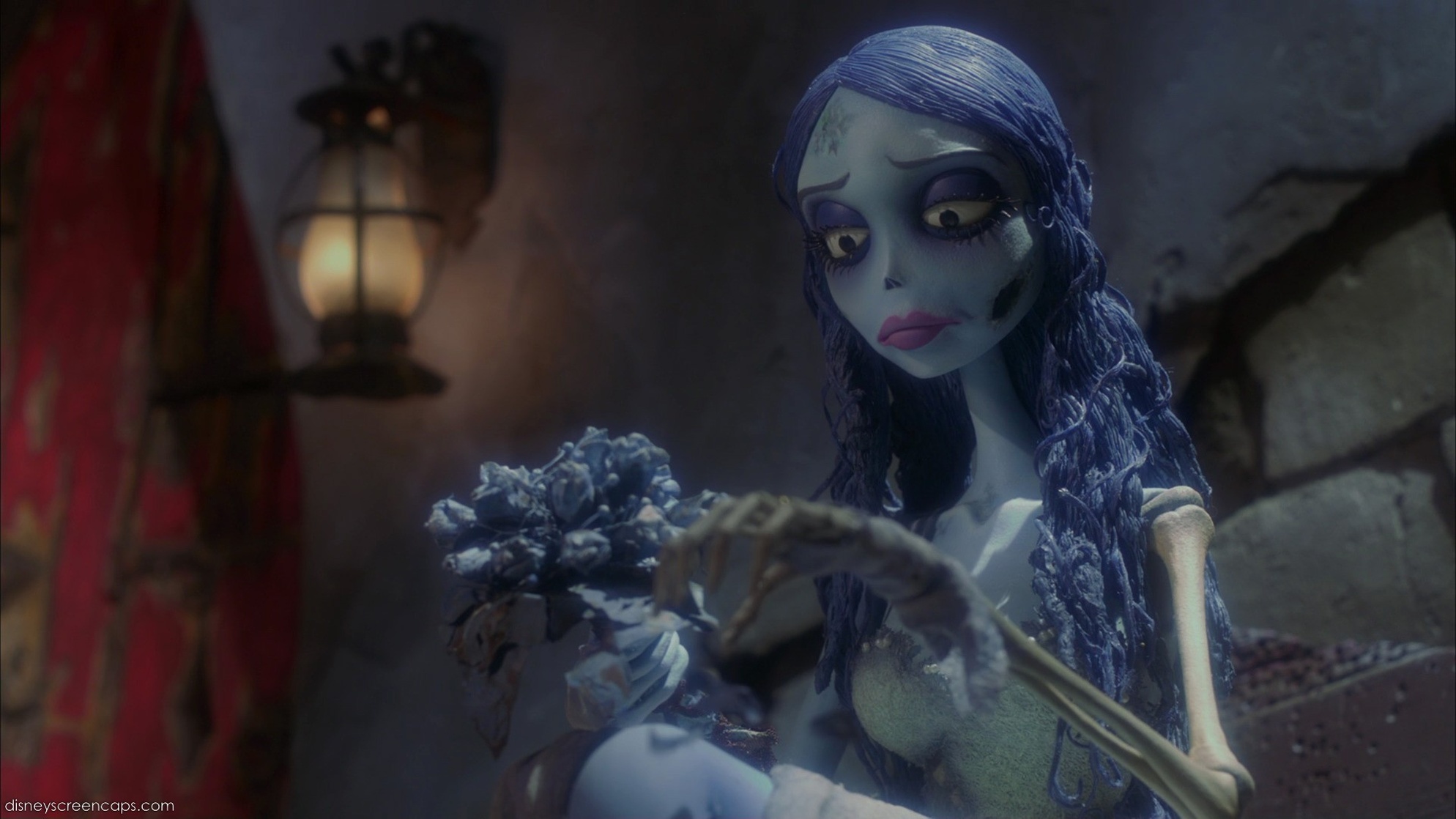
The visual style of this film is enriched by the use of stop motion, there is texture everywhere. Detailed sets and attention to detail in the craft is something you can really appreciate. In this scene (pictured above), you can see the attention to detail such as which helps to create vibrant and engaging worlds. The physicality of stop motion is something most filmmakers take advantage of as brings in more lighting, depth and shadows that stop motion enhances so easily.
Corpse Bride has a very black & white tonal palette that also includes a lot of blue. Overworld scenes are contrasted with the underworld with their use of colour. Ironically the overworld is more monotone and grim compared to the more colourful underworld, an obvious visual trick to make the point that the 'dead are more alive than the living'.
As this is my first case study, I probably haven't covered all aspects that I may want to. To help with future case studies, based on this film, my analytical framework can be summarised as:
- Understand how stop motion is used in the film.
- Identify common themes and techniques.
- Compare this film against other films and the themes or techniques other films use.
- Update analytical framework.
I will go into the next case study with a better understanding of what to look for that will be more beneficial to analyse and that can better inform my practice.
Thursday, 1 October 2015
Research Question
This week we were asked to try and summarise and explain our research question to others in the class. Although I didn't have a question in mind, I put pen to paper to try and construct a research aim that my project might fit into. I initially came up with:
"Exploring visual appeal of stop motion animation, why it might be preferred over CGI?"
And I'd answer this by looking at the feeling of physicality in the animation medium, how stop motion is being pushed to achieve new visual effects and how the applications of stop motion might be applied elsewhere such as in other animation mediums or platforms such as games and other interactive media.
I also gave a little thought into the final outcome of my project. I might want to "dumpster dive" for materials, where I could try animating with lots of different random materials and explore their effect on the quality of the animation. For exercises I could make animate something in 3D and stop motion and compare and contrast the two.
During the practical session I came up with a few other research question/aims to better reflect and refine what I wanted to do this year:
"What is the appeal of stop motion and how can it be applied to other media?"
"What are the visual qualities of stop motion and why are they appealing?"
"Explore and apply the unique visual qualities of stop motion within a digital project."
These were the questions I used to explain what I wanted to do with the project to my classmates. The feedback I got from this exercise were:
"Exploring visual appeal of stop motion animation, why it might be preferred over CGI?"
And I'd answer this by looking at the feeling of physicality in the animation medium, how stop motion is being pushed to achieve new visual effects and how the applications of stop motion might be applied elsewhere such as in other animation mediums or platforms such as games and other interactive media.
I also gave a little thought into the final outcome of my project. I might want to "dumpster dive" for materials, where I could try animating with lots of different random materials and explore their effect on the quality of the animation. For exercises I could make animate something in 3D and stop motion and compare and contrast the two.
During the practical session I came up with a few other research question/aims to better reflect and refine what I wanted to do this year:
"What is the appeal of stop motion and how can it be applied to other media?"
"What are the visual qualities of stop motion and why are they appealing?"
"Explore and apply the unique visual qualities of stop motion within a digital project."
These were the questions I used to explain what I wanted to do with the project to my classmates. The feedback I got from this exercise were:
- Mess about with stuff, make media tests, indulge, things happen through the making.
- Look at Quay Brothers for stop motion inspiration.
- Make stuff - find the question through making.
- Find out why was stop motion the "go-to" for visual effects back in the day?
- Identify more of my inspirations.
Monday, 28 September 2015
Animating with Rice
In order to push away from familiarity I wanted to try stop-motion animating with different types of materials.
I first thought of rice but hadn't actually seen an animation with rice before (sand is quite popular). I looked into other rice animations out there and have analysed them below.
This however is my attempt at animating with rice:
Not in anyway a technical feat or anything close to my best work but it was fun to try something different.
Most of the other rice animations I found often featured the rice forming to make shapes and then they would shift around.
I enjoy this one in particular because of how each grain of rice has been successfully moved along in each frame. The animator has obviously spent a lot of time ensuring there is an equal movement throughout all the rice:
However I find the last animation listed here my favourite because I think it successfully utilised the quality and texture of the rice and matched it with music that suits the look. Unlike the smoother animation above, this retains the randomness and jumpiness that comes with animating hundreds of objects at once. The music's quick pace mixed with the abstract nature of the video enhances the style.
I also like the way colour, light and exposure is used to blend the rice together into abstract shapes.
I first thought of rice but hadn't actually seen an animation with rice before (sand is quite popular). I looked into other rice animations out there and have analysed them below.
This however is my attempt at animating with rice:
Not in anyway a technical feat or anything close to my best work but it was fun to try something different.
Most of the other rice animations I found often featured the rice forming to make shapes and then they would shift around.
I enjoy this one in particular because of how each grain of rice has been successfully moved along in each frame. The animator has obviously spent a lot of time ensuring there is an equal movement throughout all the rice:
However I find the last animation listed here my favourite because I think it successfully utilised the quality and texture of the rice and matched it with music that suits the look. Unlike the smoother animation above, this retains the randomness and jumpiness that comes with animating hundreds of objects at once. The music's quick pace mixed with the abstract nature of the video enhances the style.
I also like the way colour, light and exposure is used to blend the rice together into abstract shapes.
Tuesday, 22 September 2015
Questions - Continued
Following the exercise on writing down questions I expanded on some of them. After meeting with Lynn Parker it seemed I was missing questions regarding stop-motion even though it is one of the animation mediums I am most interested in exploring this year.
One of the questions I wrote down was "What about animation interests me?" To expand upon that I ask myself "What about stop-motion animation interests me?" This is a question I'm not sure I can even fully answer and will no doubt play a part in my project in some way or another.
Stop-motion animation appeals to me because like any animation medium, its mesmerising to see something come to life. Everyone as a child has played with their toys, moving them around and pretending as if they are alive. I see stop motion as the next level up, taking that imagination and making it real.
The physicality of stop-motion particularly interests me, I like building things and working with my hands. I'm not a particularly strong drawer so having something physical to work with means I don't have to worry about maintaining volumes or keeping character drawings consistent.
I'd like to expand on this further and have began reading "Stop Motion: Passion, Process and Performance" in a hope to understand more about the finer details of stop motion.
Over the next few weeks I'll also do some media tests involving different stop motion materials and look further into the features of stop motion that I want to explore further into.
A couple of other questions I could explore:
One of the questions I wrote down was "What about animation interests me?" To expand upon that I ask myself "What about stop-motion animation interests me?" This is a question I'm not sure I can even fully answer and will no doubt play a part in my project in some way or another.
Stop-motion animation appeals to me because like any animation medium, its mesmerising to see something come to life. Everyone as a child has played with their toys, moving them around and pretending as if they are alive. I see stop motion as the next level up, taking that imagination and making it real.
The physicality of stop-motion particularly interests me, I like building things and working with my hands. I'm not a particularly strong drawer so having something physical to work with means I don't have to worry about maintaining volumes or keeping character drawings consistent.
I'd like to expand on this further and have began reading "Stop Motion: Passion, Process and Performance" in a hope to understand more about the finer details of stop motion.
Over the next few weeks I'll also do some media tests involving different stop motion materials and look further into the features of stop motion that I want to explore further into.
A couple of other questions I could explore:
- What is appealing about the visual quality of stop-motion?
- Why would stop-motion be used over 3D computer animation?
- How does the process of stop-motion influence the content of the animation?
- How do the imperfections of stop-motion actually enhance the animation?
Friday, 18 September 2015
Exploring My Interest in Animation
A lot of the questions I wrote down in this week's tutorial were mostly related to the final product and what it would be made from.
I felt it would be beneficial to look into the features I like in animation other than the craft. I wrote down things such as film-making techniques and narrative and characterisation features that interest me in other animated works.

These aren't necessarily topics to focus my entire research around but they are things I may want to incorporate into my project. It felt better to write these thoughts down rather than to keep them in my head.
Thursday, 17 September 2015
Questions
Today in the "Concept Development, Pre-Production and Professional Practice" tutorial I participated in a task involving writing down questions I had. Questions about what we had on our mind and what we wanted to know about in our field of study.
These questions were originally written on a large sheet of paper where after we identified themes that were emerging. I have typed these questions up and grouped questions into themes I've identified however many questions can fit into multiple themes. I also added to some of the few questions I'd already explored in my sketchbook:

Some questions are straight forward, some obvious and some that will not be relevant to my project a few weeks down the line. It was important to put these questions on paper to try and identify a direction to focus research.
These questions ask how I may go about researching things that may inform my project:
These questions were originally written on a large sheet of paper where after we identified themes that were emerging. I have typed these questions up and grouped questions into themes I've identified however many questions can fit into multiple themes. I also added to some of the few questions I'd already explored in my sketchbook:

Some questions are straight forward, some obvious and some that will not be relevant to my project a few weeks down the line. It was important to put these questions on paper to try and identify a direction to focus research.
These questions ask how I may go about researching things that may inform my project:
- What do animators like to research?
- What are animators currently researching?
- What research projects have animators done in the past?
- What books do I want to read?
These questions focus more on what animation medium I may want to explore:
- What animation medium do I want to use?
- Should I mix animation mediums?
- What are good examples of mixed medium animation?
- Why are mixed medium animations good?
- Why where those mixed medium animations made?
- How are stop-motion animators doing outside of a studio environment? (i.e. can I animate outdoors?)
This set of questions concerns what kind of final product I want to make:
- Should I make a short film, a series of short films or an interactive piece?
- What story do I want to tell?
- Should I focus on enhancing a style of animation?
- Whose story do I want to tell?
- Should I come up with a story first or let my research guide me into developing a story?
- Should I put more focus on narrative and characterisation?
- Why should I put more focus on narrative and characterisation.
I also had a few technical questions that involve the limitations of my own skills and scope:
- How would I make a 3D computer animated film without being too knowledgeable in 3D modelling or rendering?
- How would I go about including music that would fit an animation I had made?
- How are minimalist environments/backgrounds used effectively?
The final set of questions involves ideas I had and how I may go about developing them further, as well as general questions about things I want to find out more about:
- How can I incorporate audience interaction into an animation?
- Why is humour so often used in animation?
- How do I keep my humour in animation spontaneous without being affected by storyboards and dwelling on story beats and story refinement?
- Can nostalgia be factored in to an animation style?
- What makes animation interesting/important to me?
To summarise, there are a lot of questions here. Some of these are the right questions to ask, others not so much. There are also questions I've yet to identify and I need to think on this some more. Following this, I will consider which questions are important to explore and which ones I would like to research in to. Hopefully this is a step closer into identifying a larger research question that will become my the subject of my dissertation.
Monday, 14 September 2015
Mind Map
To begin working out a direction on what to do and what to research I made a mind map on some of the rogue thoughts and ideas floating around my head.
This mind map deals mostly with the medium of animation I want to work with and in doing so I hope to identify some mediums that can be combined or blended.

I also wrote down some strengths and weaknesses I have to hopefully work out the best route to take this year. Obviously I want to play to my strengths as much as possible but also hopefully work on a few of my weaknesses.
Some ideas on the final artefact of this project include:

These are ideas that are more of "I wonder how I'd make that?" thoughts that have crossed my mind. I'm more than sure that I'll look back on these ideas in the future and have different thoughts on them. I'm hoping that through research and practice I'll form a better base for any research question and final product I'll make.
Friday, 11 September 2015
First Post
Hello and welcome to my honours year blog. This is week one and ahead of me is a year which I have no idea will pan out. All I know is there will be a lot of researching, a lot of work and a lot of stress. However I hope this year will also be inspiring, enjoyable and allow me to develop my skills.
What I've began to consider so far is what I will want to be making this year. I want to continue focusing on animation as my main specialisation, in particular: 3D computer animation.
Researching and practising in animation may lead me to produce a short animated film as my final product, but I may also end up creating a series of animations or another piece which involves animation.
I have a couple of ideas in mind which I want to expand upon, these include mixing animation mediums such as 3D animation with stop-motion or live action film footage. Over the summer I have been working on stop-motion projects and really enjoying it, I would love to incorporate stop-motion into my project somehow if its possible. This is an excerpt from my sketchbook mapping out which animation types could mix:

On the narrative and characterisation side of things, I've not yet thought about what to explore. One idea I did have was animating stop-motion characters in real life locations, I would use the locations to tell the stories of the people who lived there.
So as you can see, a few ideas and a vague direction in which to go in. Obviously I've got a lot of research ahead of me. I will look into books that can help guide me in the right direction and discuss with others which ideas are worth developing.
What I've began to consider so far is what I will want to be making this year. I want to continue focusing on animation as my main specialisation, in particular: 3D computer animation.
Researching and practising in animation may lead me to produce a short animated film as my final product, but I may also end up creating a series of animations or another piece which involves animation.
I have a couple of ideas in mind which I want to expand upon, these include mixing animation mediums such as 3D animation with stop-motion or live action film footage. Over the summer I have been working on stop-motion projects and really enjoying it, I would love to incorporate stop-motion into my project somehow if its possible. This is an excerpt from my sketchbook mapping out which animation types could mix:

So as you can see, a few ideas and a vague direction in which to go in. Obviously I've got a lot of research ahead of me. I will look into books that can help guide me in the right direction and discuss with others which ideas are worth developing.
Subscribe to:
Posts (Atom)