This week I've started animating a small scene revolving around a space exploration rover, making its way across the surface of another planet. It originally started out as a few doodles and an idea about making a clockwork spider. While I did end up building a spider character from this, it was another character model that I was intrigued by and tried animating with.
Following the first shot, I drew up this storyboard in order to help me plan out what to do with the rest of animation. I want to use the range of movements I built into the character, and hopefully capture the quality of stop motion movement in the movements of this character.
The short story presented here is mostly to show the curiosity of the rover character in a short amount of time. A lot of this will come from the pacing, giving enough pauses to emphasise the characters inner thoughts.
Thursday, 22 October 2015
Sunday, 18 October 2015
Scotland Loves Animation - Education Day 2015
Earlier this weekend I was able to attend the Scotland Loves Animation - Education Day, a series of talks held at Edinburgh College of Art.
Although the subject of the talks were mainly orientated around Japanese animation, I still found it to be educational. This blog post will mostly contain my observations, notes and discussions regarding these talks. While they may not directly apply to my project, they did expand my knowledge on animation as a whole which is beneficial in the long run.
Hibiki Yoshizaki, in addition to Mahiro Maeda explained that the Japanese animation market is changing: anime used to make money through DVD sales, theatre tickets and TV broadcasts. That portion of revenue is falling as internet as a platform is growing in use.
While the Japanese market has been slow to adapt, it is making progress such as the Animator Expo which is utilising the online reach to expose new unknown talent and give them a chance to collaborate and express their ideas.
The new talent are making use of new technology while still maintaining traditions in Japanese animation which help to define its style and charm. Mahiro Maeda showed some of his own work which often featured hand drawn characters, composited into a 3D environment, He also showed how he put a lot of focus on compositing to ensure emotions in scenes come across strong.
Most people in the room were surprised to learn Mahiro Maeda had directed and animated the ME!ME!ME! music video, a reasonably well known animation that had some controversy in Japan but was well admired in the West for its risqué nature. The use of new technology helped aid the creation of the animation and allowed it to be composed in digital stage space with traditional drawings, further enhanced with digital paint data. And although 3D is the big thing, he'll always have an appreciation for the Japanese traditional animation culture.
Tom Bryant, the founder and creative director of Interference Pattern then gave a short history of his journey into the animation industry. I found this particularly interesting as a student also looking to work in the animation industry. Bryant showed some of his work including some from his time at Axis Animation and Passion Pictures.
He told us about how he formed his own animation studio after working for others, he outlined the potential challenges a studio can face such as securing a steady supply of work and finding artists with required skill-sets.
Bryant also gave us an idea of what employers look for in graduates:
- Good level of ability in chosen field.
- Show desire and potential.
- Teamwork.
- Never say no, don't take no for an answer.
- If you don't know how to do something, take the job and work it out.
- Stay in touch.
He gave us some tips and advice which is probably what I'll find the most useful from the talks, which included:
- To search for opportunities.
- Read forums and books, find techniques to try.
- Aim to overachieve, try something new.
- Look out for paid internships and trainee placements.
- Be realistic
- Keep on trying.
I find this especially relatable as someone who wants to work in the animation industry and there are often times of doubt and uncertainty of what I'll be doing in the future. Advice like this is reassuring that there are others in the same situation and that if you keep trying you'll get somewhere.
Finally Jonathon Clements gave a talk on the current state on the anime industry which was based more on statistics and trends. The biggest feat is that Studio Ghibli may eventually shut down feature film production. Studio Ghibli have typically taken in 5x more money than the second highest grossing anime film due to their worldwide presence.
He explained there was a problem in having one visionary director such as Hayao Miyasaki as the face of a company, because when they leave there will be a difficult decision on who to replace the visionary director. Statistics show that there is a 62.4% brand loyalty to Miyazaki whereas only 43% for Studio Ghibli. They tried using Miyazaki's son to lead the studio but that not work, and luring Hayao Miyazaki back for one last film is only a temporary measure. Like Disney, Studio Ghibli are trying to create a more reliable income by opening up a theme park.
For animated movies to be profitable they have to be in the top 20. However even a loss on paper is not always a loss in money, as the production committee funding the movie often get something out of it in the form of advertising or merchandise,
There is also a worry about money for TV animation as well, as there are a greater number of channels there is less of a market share for an individual program. Content creators are responding to a generation of single 30-something males who have more of a disposable income by focusing a lot on merchandise,
Although more technical and statistic based I found the talk very interesting as it is good to know how all aspects of the animation industry are performing. It is a rapidly changing industry that has to adapt to many things and understanding as much as you can seems important to be able to adapt to future changes in the industry.
Saturday, 10 October 2015
Inspirations and Influences
In this week's practical session we were asked to consider our interests and influences that might help to shape our project.
- What about stop motion do I want to explore?
- What do I want to learn?
- Is stop motion digital enough?
- What have I found out so far?
- What practice tasks can I do?
For concept development we will look at other artist's work and reflect on visual influences (how/what/why is the visual meaning on the work?)
We were asked to list visual things that we like:
- Architecture - Gothic, Victorian
- Tim Burton
- Laika Animation
- Batman: The Animated Series (Bruce Timm's art)
- Superheroes
- Pixar Animation
To which I expanded into a larger mind map:
I have already watched a few films from my inspirations such as Laika and Tim Burton which I plan to analyse in a further case study.
Wednesday, 7 October 2015
Texture in Stop Motion
I've always associated stop-motion with an animation medium that you could touch. The process of stop-motion and the use of real world materials means that stop-motion gets a lot of free texture and realism that CG has to put a lot of work into to get a similar result.
But I don't just mean "texture" as would be used in a Games or 3D Animation sense, but as Barry Purves (Stop Motion: Passion, Process and Performance) more adequately puts it as:
"...several worlds: texture, richness, space, depth, movement, shadow, lighting, physicality. They are all qualities stop motion has in abundance. It's about textures that move in a credible space."
I think this clip from Tim Burton's A Nightmare Before Christmas shows how texture can increase the visual quality of the film.
Monday, 5 October 2015
Case Study - Corpse Bride
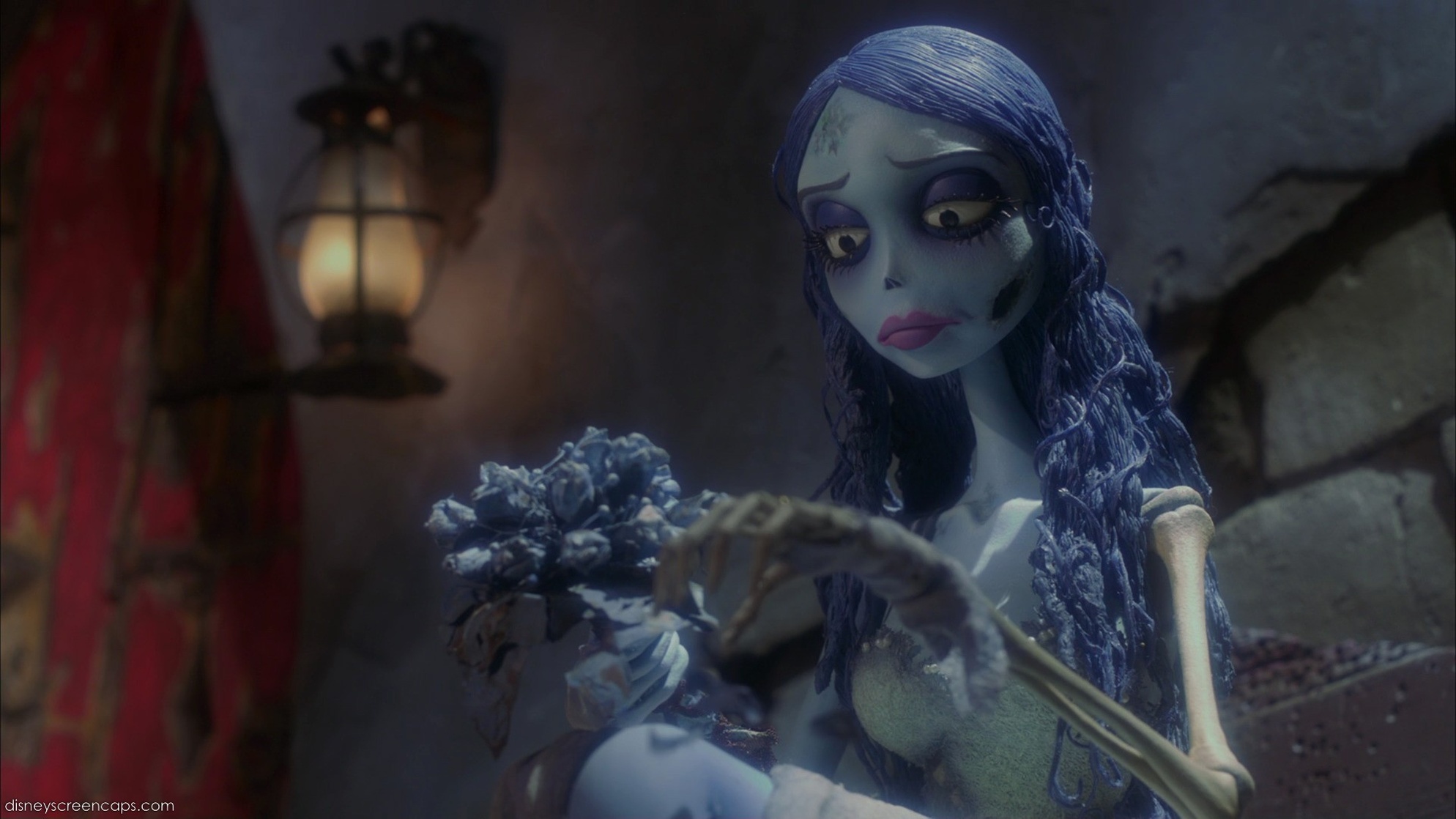
Corpse Bride is a 2008 feature length stop motion animation co-directed by Tim Burton and Mike Johnson. This case study will hope to analyse the film's use of stop motion animation, what techniques are being used, and why the use of stop motion in the movie is appealing to the audience.
At first glance it is a visually similar movie to Tim Burton's earlier Nightmare before Christmas. The characters feature long limbs and are almost skeletal in nature, even the "living" characters. I think this helps with the creepy, gothic, surreal aspect of the film's content. For example many characters are undead, and while this would come across quite scary in live action, its tamed down for a more general audience in this movie but it doesn't lose that creepiness.
Setting
This film doesn't try to hide that it’s not a stop motion movie. The characters and settings have physicality to them that the audience can connect to. There is a great use of texture in the set locations, particularly in the underworld and the town.
The visual style of this film is enriched by the use of stop motion, there is texture everywhere. Detailed sets and attention to detail in the craft is something you can really appreciate. In this scene (pictured above), you can see the attention to detail such as which helps to create vibrant and engaging worlds. The physicality of stop motion is something most filmmakers take advantage of as brings in more lighting, depth and shadows that stop motion enhances so easily.
Corpse Bride has a very black & white tonal palette that also includes a lot of blue. Overworld scenes are contrasted with the underworld with their use of colour. Ironically the overworld is more monotone and grim compared to the more colourful underworld, an obvious visual trick to make the point that the 'dead are more alive than the living'.
As this is my first case study, I probably haven't covered all aspects that I may want to. To help with future case studies, based on this film, my analytical framework can be summarised as:
- Understand how stop motion is used in the film.
- Identify common themes and techniques.
- Compare this film against other films and the themes or techniques other films use.
- Update analytical framework.
I will go into the next case study with a better understanding of what to look for that will be more beneficial to analyse and that can better inform my practice.
Thursday, 1 October 2015
Research Question
This week we were asked to try and summarise and explain our research question to others in the class. Although I didn't have a question in mind, I put pen to paper to try and construct a research aim that my project might fit into. I initially came up with:
"Exploring visual appeal of stop motion animation, why it might be preferred over CGI?"
And I'd answer this by looking at the feeling of physicality in the animation medium, how stop motion is being pushed to achieve new visual effects and how the applications of stop motion might be applied elsewhere such as in other animation mediums or platforms such as games and other interactive media.
I also gave a little thought into the final outcome of my project. I might want to "dumpster dive" for materials, where I could try animating with lots of different random materials and explore their effect on the quality of the animation. For exercises I could make animate something in 3D and stop motion and compare and contrast the two.
During the practical session I came up with a few other research question/aims to better reflect and refine what I wanted to do this year:
"What is the appeal of stop motion and how can it be applied to other media?"
"What are the visual qualities of stop motion and why are they appealing?"
"Explore and apply the unique visual qualities of stop motion within a digital project."
These were the questions I used to explain what I wanted to do with the project to my classmates. The feedback I got from this exercise were:
"Exploring visual appeal of stop motion animation, why it might be preferred over CGI?"
And I'd answer this by looking at the feeling of physicality in the animation medium, how stop motion is being pushed to achieve new visual effects and how the applications of stop motion might be applied elsewhere such as in other animation mediums or platforms such as games and other interactive media.
I also gave a little thought into the final outcome of my project. I might want to "dumpster dive" for materials, where I could try animating with lots of different random materials and explore their effect on the quality of the animation. For exercises I could make animate something in 3D and stop motion and compare and contrast the two.
During the practical session I came up with a few other research question/aims to better reflect and refine what I wanted to do this year:
"What is the appeal of stop motion and how can it be applied to other media?"
"What are the visual qualities of stop motion and why are they appealing?"
"Explore and apply the unique visual qualities of stop motion within a digital project."
These were the questions I used to explain what I wanted to do with the project to my classmates. The feedback I got from this exercise were:
- Mess about with stuff, make media tests, indulge, things happen through the making.
- Look at Quay Brothers for stop motion inspiration.
- Make stuff - find the question through making.
- Find out why was stop motion the "go-to" for visual effects back in the day?
- Identify more of my inspirations.
Subscribe to:
Posts (Atom)